
The history of coral in Marseille.
Always
Mythologically, culturally, and commercially, coral holds a special place in Marseille. It's not widely known, but our city was one of its capitals for a long time during the Middle Ages. Fiercely sought after, coral led to numerous rivalries with our Neapolitan neighbors. But it also brought wealth to the Compagnie du Corail (Coral Company), founded in Marseille in the 15th century by the Lenche family. The Lenche family gave its name to the current Place de Lenche, located not far from our workshop, behind Marseille's city hall, in the historic Panier district.
Century after century, despite a leading position in the transformation of coral into jewelry, Marseille will give way to Torre del Greco in Naples.
However, for the past year and a half, the coral workshop has resurfaced, and is restoring Marseille to its former marine splendor.
Nowadays
Jonas is one of the last coral fishermen in Marseille. He returns from his fishing trip late in the morning, summer and winter. Basket of coral in hand, he heads towards Le Panier district, taking the route to his workshop just as the coral fishermen of yesteryear did.
The days of Marseille, the capital of coral and coral fishermen, are long gone. There aren't many left. Or rather, let's say there's one, once again!
Those old Marseille coral fishermen must be turning in their graves. Not out of fear, but because a coral fisherman and his partner have taken up the torch, illuminating with their energy a craft that no one thought would be seen again in Marseille anytime soon.
Coral in mythology
The mythological origin of coral has its roots in ancient Greece and Rome.
The poet Ovid (43 BC – 17 AD) wrote Metamorphoses, a poem that recounts the adventures of Perseus. During a battle, the hero of Greek mythology cut off the head of Medusa, a sea monster with her famous hair of snakes. She was fearsome and could freeze anyone who met her gaze.
In the open air, Perseus placed Medusa's head on a bed of seaweed at the water's edge. Medusa's blood transformed the seaweed into red stone: Coral was born.
But scientifically, biologically…
what is coral?
Mineral? Vegetable or animal?
It was a doctor from Marseille, Jean-André Peyssonnel, who in 1725 determined the nature of coral. In 1816, Georges Cuvier gave the aquatic specimen its Latin name: Corallium rubrum, or Mediterranean red coral.
Mediterranean red coral is a marine vertebrate!
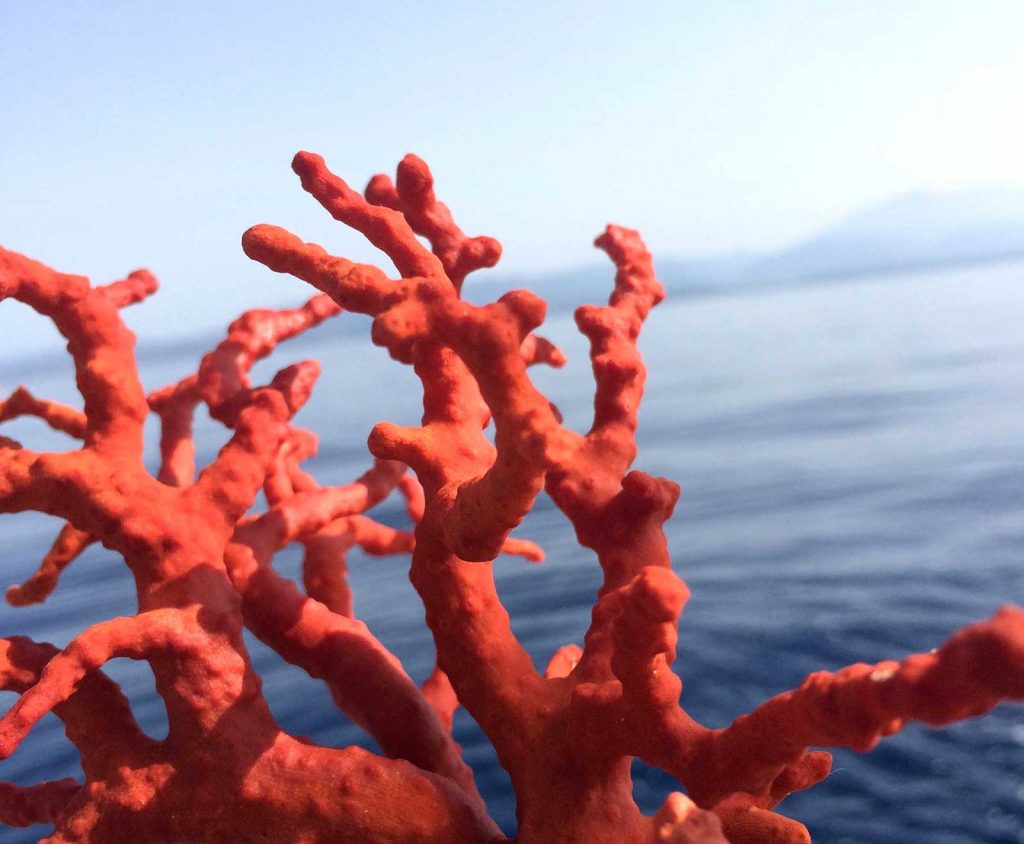
Also considered a "flower-animal", red coral grows in colonies attached to rocky bottoms. They are most often found between 30 and 400 meters deep.
Red coral feeds on tiny organic particles suspended in the water.
It reproduces sexually (in this case, fertilization occurs via sperm released into the water which drift with the ocean currents) or asexually, by budding.
Its growth is very slow. That's why it's important to be very precise when harvesting it. Branches that still need to grow should be left, and only those with market value should be harvested.
Unfortunately, some countries do not comply with these regulations. Yet they are essential if we wish to preserve the natural habitat of red coral, which is itself an important player in marine biodiversity.
The tip
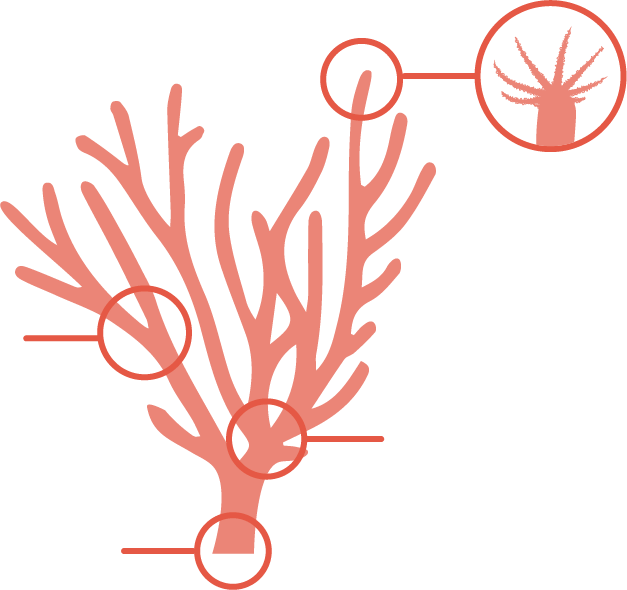
The
Barbary
The part
The foot
Red coral fishing is
a regulated activity in order to preserve the ecosystem.
At what size can coral be harvested?
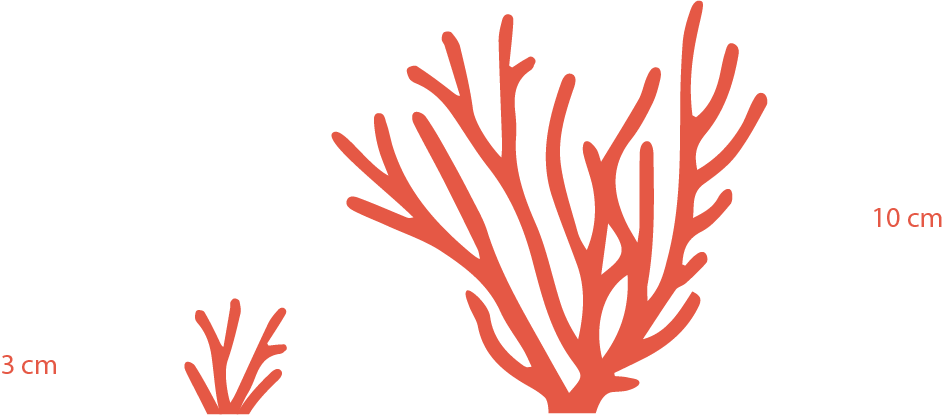
Coral is fertile from 3cm of growth but it has no commercial value.
10cm is the ideal size to start harvesting coral. But the diameter of the base must be greater than 7mm.
In the very beginning, fishing was done by hand by free divers.
Various techniques then emerged, some more harmful than others to the marine ecosystem. The "St. Andrew's cross," for example: archaic and illegal since 1983, it was dragged along the seabed, taking with it corals and other species without distinction. It was impossible to determine whether the harvested corals were mature or juvenile.
Fishing techniques have fortunately evolved and coral divers now dive with self-contained equipment.
Examples of rules in force:
• Coral becomes fertile once it reaches 3cm in growth. It is therefore essential to let them thrive undisturbed.
• Corals smaller than 10cm have no commercial value. The diameter of the base must also be greater than 7mm.
• The number of coral fishermen is limited in France. A license is only issued to them after a long training course.
• The harvest of red coral from the Mediterranean is limited in weight for each coral harvester.
Selective fishing and compliance with regulations helps to protect the seabed and to highlight the counterfeit coral which unfortunately exists in large quantities.